
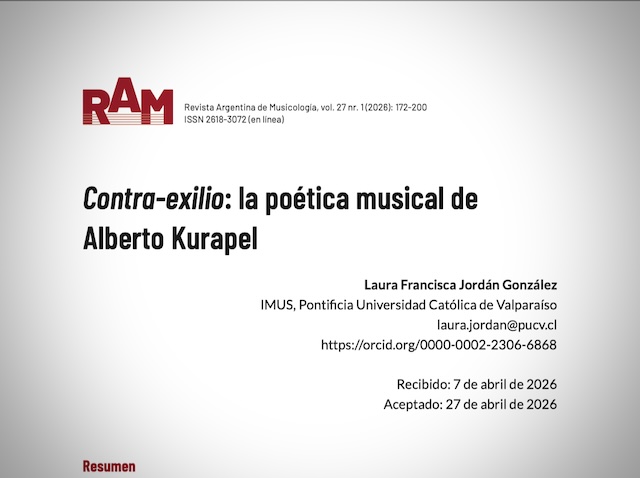
Contra-exilio: The Musical Poetics of Alberto Kurapel
Keywords:
phonography, music aesthetics, exileAbstract
This article aims to examine the poetics of contra-exilio in the work of performing artist Alberto Kurapel through an analysis of some of his essays and his discography from the 1980s, which includes the albums Contra-exilio (1982), Guerrilla (1986), and Confidencial urgent (1989). It is argued that his work undergoes a crucial shift with the emergence of the Compagnie des Arts Exilio and its conceptualization of performance theater. The analysis explores the dialogue between essay and music, and discusses key concepts in his work such as dislocation and in-between-place. It is argued that the poetics of contra-exilio crystallize in the discography through procedures of sonic friction and the expansion of vocality. Ultimately, the study examines how Kurapel’s musical work sheds light on unexplored aspects of his artistic practice and, more specifically, on his aesthetic thought.
Editorial History:
Received: April 7, 2026
Accepted: April 27, 2024
Downloads
References
Baizil, Patrice. Review of [“Carta de ajuste ou nous n’avons plus besoin de calendrier”]. Jeu 52 (1989): 217–217.
Barbero, Jesús Martín y Ana María Ochoa Gautier. “Políticas de multiculturalidad y desubicaciones de lo popular. En Cultura, política y sociedad. Perspectivas latinoamericanas, compilado por Daniel Mato, 111-125. Buenos Aires: CLACSO, Consejo Latinoamericano de Ciencias Sociales, 2005.
Cáceres, Susana. “exiTlio in pectore extrañamiento: Resistencia cultural y memoria en el teatro-performance de Alberto Kurapel”. Actos 10 (2023): 2-24.
Campos-Pérez, Marcy, Jordán-González, Laura y Rodríguez-Aedo, Javier. “Transfonografías del exilio chileno en Europa”. Revista Musical Chilena 76, nro. 237 (2022): 9-43. https://dx.doi.org/10.4067/S0716-27902022000100009
Carrasco, Eduardo. Quilapayún. La revolución y las estrellas. Santiago: RIL, 2003.
Cattaneo, Claudia. “La memoria del exilio recuperada en el cuerpo utópico de la escena: el cuerpo y el sonido en la puesta en acción de Prometeo encadenado según Alberto Kurapel" (1988)”. Acotaciones 45 (julio-diciembre 2020): 187-222.
Eidsheim, Nina Sun. Voice as a technology of selfhood: Towards an analysis of racialized timbre and vocal performance. Tesis doctoral, University of California, 2008.
Freedman, Jesse. “Political Participation and Engagement in East Germany Through Chilean Nueva Canción”. Yearbook for Traditional Music 54, nro.1 (2022):1-25. doi:10.1017/ytm.2022.4
Gavagnin, Stefano, Laura Jordán González y Javier Rodríguez Aedo. "Fronteras porosas, sonidos conectados: transnacionalidad de la Nueva Canción a través de sus escritos" Cuadernos de Música Iberoamericana 35 (2022): 39-71.
Gay, Michel. “L’interculturelle”. Lettres québécoises26 (1982): 16.
Gelbart, Matthew. The Invention of Art Music and Folk Music. Cambridge: Cambridge University Press, 2007.
Halliwell, Stephen. “Setting the scene”. En Between Ecstasy and Truth Interpretations of Greek Poetics from Homer to Longinus. Oxford: Oxford University Press, 2011.
Jordán González, Laura. “Garganta de piedra: el canto artificial de Alberto Kurapel y la recepción de chilenos exiliados en Montreal durante los setenta”, Resonancias 18, nro. 34 (2014): 15-35.
Krims, Adam. Rap Music and the Poetics of Identity. Cambridge: Cambridge University Press, 2000.
Kurapel, Alberto. Contra-exilio. KAU-5722-05. Montreal: APIR, 1982.
Kurapel, Alberto. Guerrilla. KAU-9-8. Montreal: APIR, 1986.
Kurapel, Alberto. Confidencial urgent. KAU-44452. Montreal: APIR, 1989.
Kurapel, Alberto. “La Compagnie des Arts Exilio (Primer Manifiesto)”. En 3 Performances Théâtrales, xvii-xix. Montréal: Humanitas, 1987.
Kurapel, Alberto. “Relación centro-periferia. La expresión de la marginalidad como componente estético del teatro-performance”. Estética de la insatisfacción en el Teatro-Performance, 41-58. Santiago: Editorial Cuarto Propio, 2004.
Kurapel, Alberto. El actor performer. Santiago: Editorial Cuarto Propio, 2010.
Kurapel, Alberto. Estación artificial: expresión escénica de exilio. Montreal: Les Éditions du Trottoir, 2011.
Lacasse, Serge. “Voice and Sound Processing: Examples of Mise en Scene of Voice in Recorded Rock Music”. Popular Musicology Online 5 (2000). http://www.popular-musicology-online.com/issues/05/lacasse.html.
Lagos-Kassai, María Soledad. “Alberto Kurapel: la incansable búsqueda del Topos propio”. Introducción a Estética de la insatisfacción en el Teatro-Performance, de Alberto Kurapel, 11-28. Santiago: Editorial Cuarto Propio, 2004.
Lefebvre, Marie-Thérèse. “Micheline Coulombe Saint-Marcoux et Marcelle Deschênes: pionnières dans le sentier de la création électroacoustique”. Circuit 19, nro. 1 (2009): 23–41. https://doi.org/10.7202/019932ar Masud Barría, Astrid. “El teatro-performance de Alberto Kurapel y la expresión sonora del exilio”. Actos 6 (2023): 25-38.
Meizel, Katherine. Multivocality: Singing in the borders of identity. Orxford: Oxford University Press, 2020.
Piedade, Acácio. “Perseguindo fios da meada: pensamentos sobre hibridismo, musicalidade e tópicas”. Per Musi 23 (2010): 103-112.
Rodríguez Aedo, Javier. “Resistencia, política y exotismo: apuntes para situar la canción política chilena en exilio”. Universum 37, nro. 2 (2022): 599-618.
Rodríguez Musso, Osvaldo. Cantores que reflexionan: notas para una historia personal de la nueva canción chilena. Santiago: Hueders, 2015.
Rodríguez Musso, Osvaldo. La nueva canción chilena: continuidad y reflejo. La Habana: Casa de las Américas, 1988.
Stravinsky, Igor. Poética musical. Barcelona: Taurus Humanidades, 1977.
Toro, Fernando de. “Identidad, alteridad y el tercer espacio: el teatro de Alberto Kurapel”, Teatrae 1 (Otoño-Invierno 2000): 73-79.
Toro, Fernando de y Alfonso de Toro, Alberto Kurapel. Teatro-Performance, Alteridad y Memoria. Santiago: Editorial Cuarto Propio, 2018.
Vujosevic Jovanovic, Sara. “’Poetics’ in Musicology: Historical Background and Methodological Frameworks. Herald of Anthropology”. Vestnik Antropologii 1 (2026): 170–180.
Additional Files
Published
Issue
Section
License
Copyright (c) 2026 LAURA FRANCISCA JORDAN GONZALEZ

This work is licensed under a Creative Commons Attribution-NonCommercial 4.0 International License.
Attribution-NonCommercial 4.0 International
https://creativecommons.org/licenses/by-nc/4.0/
You are free to:
- Share — copy and redistribute the material in any medium or format.
- Adapt — remix, transform, and build upon the material.
- The licensor cannot revoke these freedoms as long as you follow the license terms.
Under the following terms:
- Attribution — You must give appropriate credit , provide a link to the license, and indicate if changes were made . You may do so in any reasonable manner, but not in any way that suggests the licensor endorses you or your use.
- Non Commercial — You may not use the material for commercial purposes .
- No additional restrictions — You may not apply legal terms or technological measures that legally restrict others from doing anything the license permits.
Notices:
You do not have to comply with the license for elements of the material in the public domain or where your use is permitted by an applicable exception or limitation .
No warranties are given. The license may not give you all of the permissions necessary for your intended use. For example, other rights such as publicity, privacy, or moral rightsmay limit how you use the material.


 The works included in this magazine are published under the