
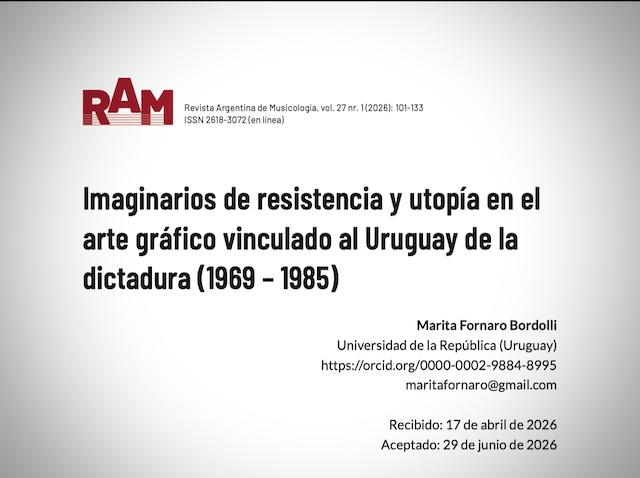
Imaginaries of resistance and utopia in Uruguayan graphic art during the dictatorship, 1969–1985
Keywords:
graphic art, popular music and resistance, Uruguayan dictatorship, visual rhetoric, imaginary and musicAbstract
Graphic art was a key tool in the strategies of resistance groups both within and outside Uruguay during the civil-military dictatorship that the country endured between 1973 and 1985, and in the years immediately preceding it. In this paper, I examine the almanacs published by the Club de Grabado de Montevideo, an institution that played a significant role in cultural resistance, and posters from various sources. The latter corpus includes handcrafted pieces, particularly from the late 1960s and the early years of the dictatorial regime, as well as works by prominent professionals such as Blankito and Carlos Palleiro. I focus particularly on the posters preserved in the Alfredo Zitarrosa Archive. I identify the main iconographic themes in these materials, amongst which the guitar stands out as a musical motif and barbed wire as a general motif. I develop an analysis based on visual rhetoric: the presence of metaphors, synecdoches, allegories and their relationship with the ideology that accompanied these activities of resistance, denunciation and solidarity.Editorial History:
Received: April 17, 2026
Accepted: June 29, 2026
Downloads
References
Alencar Pinto, Guilherme de. “Todo lo que sirva para la destrucción del Uruguay”. Vigilando la música popular en dictadura. Brecha, nro. 1954 (2023). https://brecha.com.uy/todo-lo-que-sirva-para-la-destruccion-del-uruguay/.
Bunn, Matthew. “Reimagining repression: New Censorship Theory and after”, History and Theory 54, nro. 1 (2015): 25 – 44.
Fornaro Bordolli, Marita. “Músicas populares uruguayas luego de la dictadura militar 1973–1985. Veinticinco años después del “amanecer”. En Músicas e saberes em trânsito, coordenado por Susana Moreno Fernández, Pedro Roxo e Iván Iglesias. Lisboa: Edições Colibri, 2012.
–––––. “30.5 x 30.5: Music and Image on the covers of vinyl records of uruguayan popular music”. En Music and figurative arts in the Twentith century, editado por R. Illiano, 167-192. Thurnhout: Brepols (2016).
–––––. “Censura y exilio en la creación de Alfredo zitarrosa, músico popular uruguayo. En Vínculos musicales entre España y el Cono sur americano. Migraciones y transculturación, editado por Julio Ogas, 175-196. Granada: Comares, 2024.
Fornaro Bordolli, Marita y Martín Monteiro. La tierra exige. Exilio y regreso de Alfredo Zitarrosa. Montevideo: Universidad de la República, 2024.
Gavagnin, Stefano y Marita Fornaro Bordolli, “Traveling homelands: Uruguay ‘beyond the homeland’ and the events in Mexico and Venice (1977–1978). En Music, culture and politics in Latin America, editado por Laura Jordán y Christian Spencer. Londres: Routledge (En prensa).
Lacasse, Serge. “Toward a model of transfonography”. En The pop palimpsest. Intertextuality in recorded popular music, editado por Serge Lacasse y Lori Burns, 9-60. Ann Arbor: University of Michigan Press, 2018.
Muller, Beate. “Censorship and Cultural Regulation in the Modern Age: Mappin the territory”. En Censorship and Cultural Regulation in the Modern Age, editado por Beate Muller, 1 – 31. Rodopi, 2004.
Peluffo Linari, Gabriel. “Club de Grabado: desde la crisis, con pesar”. Boletín del Club de Grabado de Montevideo, nro. 21 (1984): 1.
Razac, Olivier. Historia política del alambre de espino. Madrid: Melusina, 2009.
Santacreu, María José. “Estábamos tan bien contra los milicos…”. Brecha, 12-09-2013, s/p. https://brecha.com.uy/estabamos-tan-bien-contra-los-milicos/.
Sontag, Susan. “Posters: Advertisement, Art, Political Artifact, Commodity”. En:The Art of Revolution: 96 Posters from Cuba, editado por Dugald Stermer, 196 y ss. NuevaYork: McGraw- Hill, 1970.
Additional Files
Published
Issue
Section
License
Copyright (c) 2026 Marita Fornaro Bordolli

This work is licensed under a Creative Commons Attribution-NonCommercial 4.0 International License.
Attribution-NonCommercial 4.0 International
https://creativecommons.org/licenses/by-nc/4.0/
You are free to:
- Share — copy and redistribute the material in any medium or format.
- Adapt — remix, transform, and build upon the material.
- The licensor cannot revoke these freedoms as long as you follow the license terms.
Under the following terms:
- Attribution — You must give appropriate credit , provide a link to the license, and indicate if changes were made . You may do so in any reasonable manner, but not in any way that suggests the licensor endorses you or your use.
- Non Commercial — You may not use the material for commercial purposes .
- No additional restrictions — You may not apply legal terms or technological measures that legally restrict others from doing anything the license permits.
Notices:
You do not have to comply with the license for elements of the material in the public domain or where your use is permitted by an applicable exception or limitation .
No warranties are given. The license may not give you all of the permissions necessary for your intended use. For example, other rights such as publicity, privacy, or moral rightsmay limit how you use the material.


 The works included in this magazine are published under the