
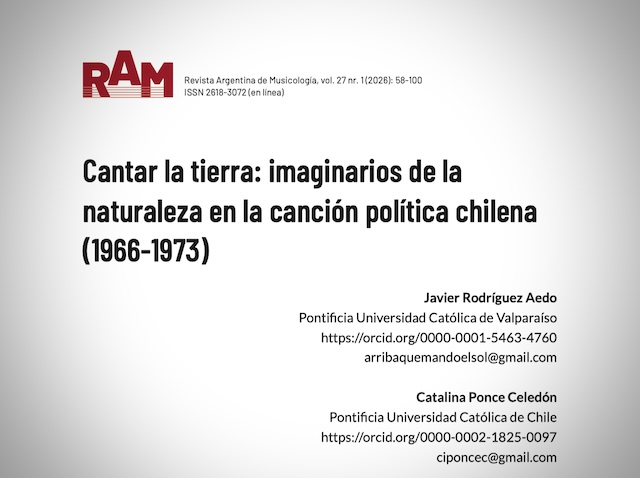
Singing of the Land: Representations of Nature in Chilean Political Songs (1966–1973)
Keywords:
Nueva Canción Chilena, imaginaries of nature, interspecies relationships, Unidad Popular, environmental humanitiesAbstract
This article examines the imaginaries of nature in Chilean political songs produced between 1966 and 1973, with a particular focus on the Popular Unity period. Through an analysis of lyrics, recordings and paraphonographic elements, two coexisting environmental imaginaries are identified in the discography of the Chilean left: one productivist, rooted in classical Marxism, which conceived of nature as a reserve of resources at the service of the revolutionary project; and another that explored alternative ways of relating to the more-than-human world, based on interdependence, care and learning. Through imagery such as the earth, animals, plants and elements of the natural environment, these songs constructed a symbolic universe which, without being presented as a rupture, gradually blurred the boundaries between the human and the non-human.
Editorial History:
Received: March 30, 2026
Accepted: July 8, 2026
Downloads
References
Abram, David. Comment la terre s'est tue. Pour une écologie des sens. París: La Découverte, 2021.
Allende Pino, Cristóbal y Elvira Rodríguez Droguett. “Simbiosis entre naturaleza y humanidad en la lectura socioecocrítica de tres canciones de Víctor Jara”. La Palabra 45 (2023): e15143. https://doi.org/10.19053/01218530.n45.2023.15143
Altvater, Elmar. “¿Existe un marxismo ecológico?”. En La teoría marxista hoy. Problemas y perspectivas. Buenos Aires: CLACSO, 2006.
Amar, Mauricio. “La persistente hacienda. Chile y la imaginación política”. Bordes 30 (2023): 59-64.
Andermann, Jens. Tierras en trance. Arte y naturaleza después del paisaje. Santiago: Metales Pesados, 2018.
Atías, Waldo. Documento de la Asamblea Nacional de trabajadores de la cultura del Partido Comunista. Santiago: Impresora Horizonte, s.f.
Binns, Niall. “Criaturas del desarraigo, o en busca de los lugares perdidos: alienación y ecología en la poesía hispanoamericana”. América Latina Hoy 30 (2002): 39-62.
Bosseur, Jean-Yves. Musique et environnement. París: Minerve, 2016.
Bouton, Christophe. L'accélération de l'histoire. París: Seuil, 2022.
Chakrabarty, Dipesh. Une planète, plusieurs mondes. París: CNRS Éditions, 2024.
Despret, Vinciane. Habitar como un pájaro. Modos de hacer y de pensar los territorios. Buenos Aires: Cactus, 2022.
Didi-Huberman, Georges. Écorces. París: Les Éditions de Minuit, 2011.
Domínguez Jiménez, Román. “Inmemorial de la carne”. En Dos ensayos sobre el terror. Del placer derivado de los objetos de terror seguido de Inmemorial de la carne, 29-75. Viña del Mar: Ordinaria Editorial, 2023.
Donoso Aceituno, Arnaldo y Juan Gabriel Araya Grandón. “Representaciones del animal en la poesía de Pablo Neruda”. Literatura: teoría, historia, crítica 18, nro. 1 (2016): 29-51. http://dx.doi.org/10.15446/lthc.v18n1.54678.
Estenssoro, Fernando. “La recepción del ambientalismo político por los comunistas y socialistas chilenos durante la Unidad Popular (1970-1973)”. Revista Izquierdas 17 (2013): 1-27.
Foucault, Michel. La Naissance de la biopolitique. París: Gallimard, 2004.
Georgi, Gabriel. Formas comunes. Animalidad, cultura y biopolítica. Buenos Aires: Eterna Cadencia, 2014.
Gilbert, Sandra M., y Susan Gubar. La loca del desván: la escritora y la imaginación literaria del siglo XIX. Madrid: Ediciones Cátedra, 1998.
Goldsmith, Jael. “Constructing maternalism from paternalism: the case of state milk programs”. En Motherhood, social policies and women's activism in Latin America, 69-87. Basingstoke: Palgrave Macmillan, 2020.
González, Anahí. “Lecturas animales de las vidas precarias. El 'discurso de la especie' y las normas de lo humano”. Tabula Rasa 31 (2019): 139-159.
González, Juan Pablo. Pensar la música desde América latina. Santiago: Ediciones Universidad Alberto Hurtado, 2018.
González, Juan Pablo, Oscar Ohlsen y Claudio Rolle. Historia social de la música popular chilena 1950-1970. Santiago: Ediciones UC, 2009.
Guillibert, Paul. Exploiter les vivants. Une écologie politique du travail. París: Éditions Amsterdam, 2023.
Haraway, Donna J. Vivre avec le trouble. París: CNL, 2020.
Harnecker, Marta y Gabriela Uribe. Capitalismo y Socialismo. Cuadernos de Educación Popular, nro. 6. Santiago: Quimantú, 1972.
Haudricourt, André. El cultivo de los gestos: entre plantas, animales y humanos. Buenos Aires: Cactus, 2019.
Herrera, Silvia. “Una aproximación a la relación música-política a través de la cantata La Fragua del compositor Sergio Ortega (1938-2003)”. Neuma 1 (2011): 10-35.
Karmy, Eileen. “Ecos de un tiempo distante. La Cantata Popular Santa María de Iquique (Luis Advis-Quilapayún) y sus resignificaciones sociales a 40 años de su estreno”. Tesis de magíster, Universidad de Chile, 2011.
Katz-Rosene, Joshua. “Canción de protesta y discursos contraculturales de resistencia en la Colombia de los años 60”. Resonancias 24, nro. 47 (2020): 13-37.
Latour, Bruno y Nikolaj Schultz. Manifiesto ecológico político. Buenos Aires: Siglo XXI Editores, 2023.
López, María Carmen. “Naturaleza y carne del mundo. Aportaciones de Merleau-Ponty a la ecofenomenología”. Ludus Vitalis 14, nro. 26 (2006): 171-186.
Lowy, Michael. Qu'est-ce que l'écosocialisme? París: Le Temps des Cerises, 2020.
Morizot, Baptiste. Manières d'être vivant. Enquêtes sur la vie à travers nous. París: Actes Sud, 2020.
Nascimento, Evando. El pensamiento vegetal. La literatura y las plantas. Santiago: Mimesis, 2021.
Pastoureau, Michel. L'historien face à l'animal. París: École Nationale des Chartes, 2023.
Programa básico de gobierno de la Unidad Popular. Santiago: Instituto Geográfico Militar, 1970.
Rink, Annika y Javier Rodríguez Aedo. “‘Hay que apresurarse y salvar lo que aún existe’: estrategias etnográficas y musicales frente a la noción de 'pérdida' en torno al folklore en el Cono Sur (Argentina y Chile, Siglo XX)”. Indiana, en prensa, 2026.
Rodríguez Aedo, Javier. “La madre del hombre nuevo se llama revolución: Música popular e imaginario del hombre nuevo durante la Unidad Popular en Chile”. Tesis de magíster, Universidad de Chile, 2010.
Rojas, Jorge y Gorka Villar. “Incentivos a la producción y la productividad, 1969-1973: Debates y dilemas en la izquierda chilena”. Hispanic American Historical Review 104, nro. 1 (2024): 85-120. https://doi.org/10.1215/00182168-10943033
Rojas, Pablo. Tráenos tu reino de justicia e igualdad: Mesianismo y Nueva Canción Chilena. Santiago: Ariadna Ediciones, 2024.
Ruiz, Reinaldo. “Los fundamentos económicos del programa de gobierno de la Unidad Popular: a 35 años de su declaración”. Universum 20, nro. 1 (2005): 152-167.
Sayre, Robert y Michael Löwy. Romantisme anticapitaliste et nature. París: Éditions Payot, 2022.
Simondon, Gilbert. Deux leçons sur l'animal et l’homme. París: Éditions Ellipses, 2020.
Singer, Peter. Liberación animal. Madrid: Taurus, 2018 [1975].
Smart, Sebastián. “La política del extractivismo: origen en dictadura y continuidad en democracia”. En Complicidad económica con la dictadura chilena. Un país desigual a la fuerza, 161-175. Santiago: LOM, 2019.
Discografía
Cortés, Rubén. “Por fin” y “A producir más”. DICAP, JJS-121, EP, 1971.
Grondona, Payo. Lo que son las cosas, ¿no? DICAP, DCP-24, LP, 1971.
Inti-Illimani. Autores chilenos. DICAP, JJL-13, LP, 1971.
Jara, Víctor. Víctor Jara. Demon, LPD-034-X, LP, 1966.
———. Víctor Jara. Odeon, LDC-36637, LP, 1967.
———. Pongo en tus manos abiertas… DICAP, JJL-30, LP, 1969.
———. Canto libre. Odeon, LDC-36726, LP, 1970.
———. El derecho de vivir en paz. DICAP, JJL-11, LP, 1971.
———. La población. DICAP, JJL-14, LP, 1972.
———. “La bala”. DICAP, JJS-143, EP, 1972.
Neruda, Pablo y Ángel Parra. Arte de pájaros. Demon, LPD-031, LP, 1966.
Parra, Ángel. Ángel Parra Vol. II. Demon, LPD-029, LP, 1966.
———. Canciones de Patria nueva / Corazón de bandido. Peña de los Parra-DICAP, DCP-18, LP, 1971.
Quilapayún. X Viet-Nam. DICAP, JJL-01, LP, 1968.
———. Vivir como él. DICAP, JJL-12, LP, 1971.
Quilmay. “Juan del Fuego” y “El cobre es nuestro”. Arena, SD-0336, EP, 1971.
Fernández, Tito. El temucano. DICAP-Peña de los Parra, DCP-31, LP, 1971.
Ortega, Sergio. La Fragua. Cantos para chilenos. DICAP, JJLS-17, LP doble, 1973.
Varios. Chile Pueblo (En El 2° Año Del Gobierno Popular). IRT, IL-124, LP, 1972.
Additional Files
Published
Issue
Section
License
Copyright (c) 2026 Javier Rodríguez Aedo, Catalina Ponce Celedón

This work is licensed under a Creative Commons Attribution-NonCommercial 4.0 International License.
Attribution-NonCommercial 4.0 International
https://creativecommons.org/licenses/by-nc/4.0/
You are free to:
- Share — copy and redistribute the material in any medium or format.
- Adapt — remix, transform, and build upon the material.
- The licensor cannot revoke these freedoms as long as you follow the license terms.
Under the following terms:
- Attribution — You must give appropriate credit , provide a link to the license, and indicate if changes were made . You may do so in any reasonable manner, but not in any way that suggests the licensor endorses you or your use.
- Non Commercial — You may not use the material for commercial purposes .
- No additional restrictions — You may not apply legal terms or technological measures that legally restrict others from doing anything the license permits.
Notices:
You do not have to comply with the license for elements of the material in the public domain or where your use is permitted by an applicable exception or limitation .
No warranties are given. The license may not give you all of the permissions necessary for your intended use. For example, other rights such as publicity, privacy, or moral rightsmay limit how you use the material.


 The works included in this magazine are published under the